5 Office Interior Trends That Increase Employee Retention in Post-Pandemic Atlanta
of employees say workspace design impacts how they feel about their employer
average cost to replace a mid-level professional in a metro market like Atlanta
more likely employees are to stay when they rate their workspace as “exceptional”
1. Flexible, Activity-Based Layouts
The open-plan office of the 2010s was designed for an era of always-present employees. Today’s workforce is hybrid, schedule-variable, and task-diverse. A senior developer needs deep-focus quiet at 10 a.m.; that same person may need a collaborative war room at 2 p.m. A single-mode office accommodates neither well.
Activity-based layouts solve this by carving the floorplate into intentional zones: heads-down focus enclaves, small-group collaboration pods, informal lounge areas for spontaneous connection, and formal conference space for client-facing work. The key is acoustic separation without visual isolation — employees should feel variety and autonomy in how they use their day without feeling hidden or disconnected from colleagues.
For Atlanta clients in the financial services, technology, and professional services sectors, we are seeing a strong shift away from assigned seating toward hoteling systems paired with ample personal storage. This requires thoughtful electrical and data rough-in planning during construction — a detail that separates a flexible office from a merely open one.
“Companies that gave employees agency over their work environment in 2023 reported meaningfully lower voluntary turnover than those that maintained assigned, static seating arrangements.”
— CBRE Atlanta Office Market Outlook, 2024
2. Biophilic Design — Nature as a Retention Strategy
Biophilic design is not a cosmetic trend. It is rooted in three decades of environmental psychology research demonstrating that human beings have a measurable physiological and cognitive response to natural elements in built environments. Lower cortisol. Faster cognitive recovery. Higher reported satisfaction with workspace quality.
In practical terms, biophilic design in a corporate office might mean living plant walls installed along primary circulation paths, the strategic use of natural wood grain and stone in break rooms and reception areas, maximizing daylight penetration through glazing upgrades and interior sightlines to windows, or incorporating water features into lobby or lounge spaces.
Atlanta is an ideal market for biophilic integration. The city’s canopy cover and moderate climate allow for interior-exterior continuity that northern markets cannot replicate year-round. Offices along I-285 and the Buckhead corridor are incorporating covered outdoor terraces, green rooftop extensions, and wood-clad interior courtyards that speak directly to Atlanta’s identity as a city embedded in nature.
From a construction standpoint, living walls require advance coordination of irrigation, waterproofing, and supplemental lighting — work that must be planned during the design development phase, not retrofitted after the fact.
3. Indoor Air Quality as a Wellness Commitment
If the pandemic reshaped how we think about office space, it fundamentally changed how employees — and their employers — think about the air inside that space. Indoor air quality (IAQ) has moved from a building code baseline to a competitive differentiator, and savvy HR and facilities leaders in Atlanta are treating it as a retention issue.
The data supports that instinct. Studies conducted by Harvard’s T.H. Chan School of Public Health found that employees in high-ventilation, low-pollutant environments scored significantly higher on cognitive function tests and reported measurably better sleep and fewer sick days than colleagues in standard commercial buildings. Retention correlates strongly with both perceived health and reported cognitive engagement.
Modern IAQ upgrades in office interior construction include the installation of MERV-13 or HEPA filtration within existing HVAC systems, the addition of ERV (energy recovery ventilation) units to increase fresh air exchange without spiking energy costs, CO₂ and VOC monitoring tied to smart HVAC controls, and the selection of low-emission paints, adhesives, and flooring materials that minimize off-gassing.
For Atlanta offices occupying Class B buildings on a retrofit budget, targeted upgrades to air handling units and the introduction of IAQ monitoring dashboards — visible to employees — can deliver measurable morale impact at a fraction of a full mechanical renovation cost.
4. Dedicated Wellness and Respite Spaces
Mental health emerged from the pandemic as a workforce issue that employers can no longer quietly ignore. The American Psychological Association’s 2023 Work and Well-Being Survey found that 77 percent of workers reported experiencing work-related stress in the prior month. For Atlanta employers competing against remote-first technology companies and flexible consultancies, the absence of visible wellness investment reads as institutional indifference.
Corporate office construction now routinely incorporates quiet rooms or “respite suites” — private, acoustically isolated spaces furnished for short-term decompression, meditation, or prayer. These are distinct from phone booths or focus pods; they are intentionally non-transactional spaces with soft lighting, comfortable seating, and no screens.
Lactation rooms and multi-faith prayer spaces fall within this same category of investment. Beyond their legal requirements under federal and Georgia law, they signal a tangible commitment to the diversity and wellbeing of the workforce — an increasingly decisive factor for candidates evaluating multiple offers in the Atlanta market.
Fitness facilities, even modest ones, represent another high-ROI wellness investment. A well-designed fitness room with a shower and changing area can eliminate one of the most common barriers Atlanta employees cite for not commuting: the inability to exercise during the workday without losing significant time to a round trip home.
5. Brand-Forward, Identity-Rich Environments
The fifth trend is less tangible but arguably the most powerful: the deliberate construction of a workspace that communicates who a company is and what it stands for. Post-pandemic employees are not simply working for a paycheck. Research consistently shows that purpose and organizational identity are among the top three drivers of retention for workers under 45 — the demographic that will define Atlanta’s workforce for the next two decades.
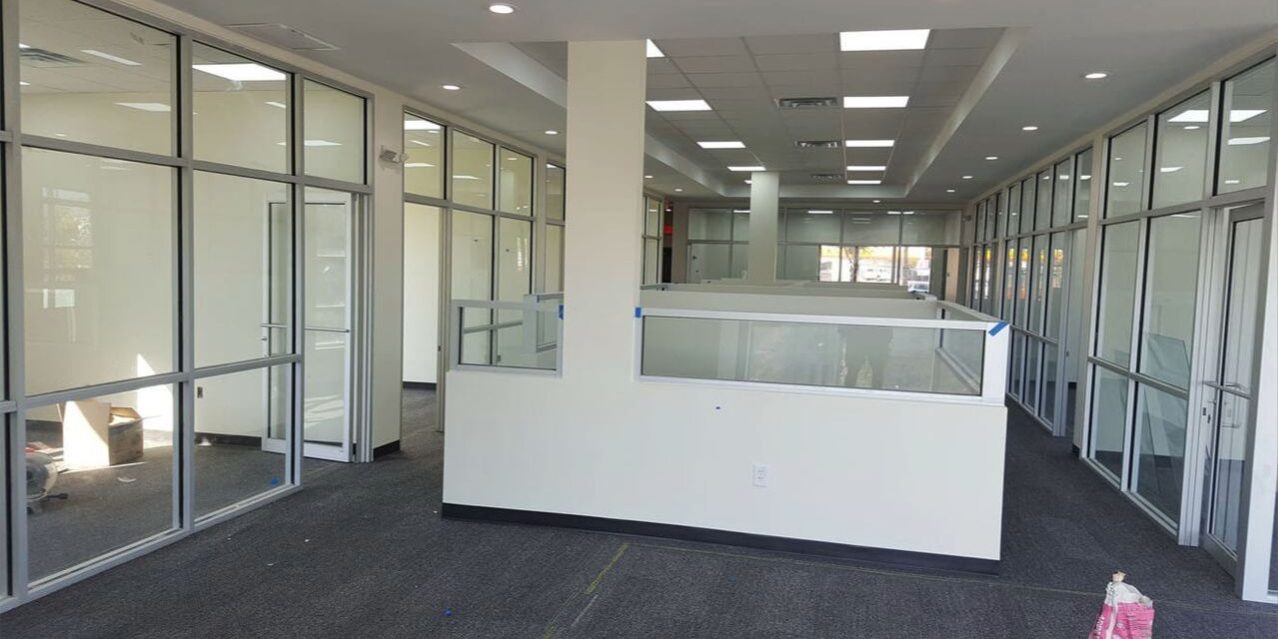
A generic Class A lease space with contractor-grade finishes, institutional carpet, and drop-tile ceilings communicates, however unintentionally, that the organization views its office as overhead rather than an investment in its people. Conversely, a thoughtfully designed space where the company’s history, mission, and culture are embedded in the architecture — through custom millwork, curated art, strategic use of brand color, and materials that tell a coherent aesthetic story — functions as a daily, passive statement of organizational pride.
We have built environments for Atlanta-based clients across banking, healthcare, logistics, and technology that have become genuine sources of employee pride. When the office becomes a place worth sharing on social media, worth bringing a family member to see, worth arriving at earlier than required — retention numbers tend to follow.
“Office design is increasingly a talent strategy, not just a real estate decision. Companies that treat their interior environment as a brand expression see measurable improvements in both recruitment speed and retention duration.”
— Atlanta Business Chronicle, Commercial Real Estate Quarterly, Q1 2025
The Atlanta Context: Why Now Matters
Metro Atlanta’s commercial office market is at an inflection point. Sublease availability has created pricing leverage for tenants willing to commit to meaningful build-outs. Construction costs, while still elevated versus 2019, have stabilized. And the competitive landscape for professional talent — with companies like Apple, Microsoft, NCR, and Delta all headquartered or significantly invested here — means that the quality of a company’s physical workspace is being evaluated by candidates alongside compensation and title.
The organizations that use this window to invest strategically in their office interiors will not just retain employees more effectively. They will attract a caliber of candidate who sees the workspace as evidence of broader organizational seriousness. That is a compounding advantage that lasts well beyond the lease term.
RTF Construction brings deep expertise in Atlanta’s commercial construction market, a network of local subcontractors, and a collaborative design-build methodology that translates retention strategy into finished, functional space — on schedule and on budget.
Ready to Transform Your Atlanta Office?
Our office interiors team works with HR directors, facilities managers, and corporate real estate professionals to design and build workplaces that employees choose to come to. Let’s talk about your space.